Rules to Write By

by Scott Marlowe (@scottmarlowe) 6/15/2010 8:48:00 PM

I'm wrapping up my second novel, a fantasy/steampunk adventure novel which I'll likely blog about in more detail soon. But as I begin to think about my next novel, I already know there's some things that I want to stay away from and some things I want to try. I'm calling these my "story rules". Think of them as guidelines; not necessarily set in stone, but I'm going to look to them as I start outlining. If and when I violate one of them, I'm going to have to rationalize such rule breaking (only to myself, of course).

As an example of a rule, a writer of fantasy might have one called "No elves". Another might be, "No quests". I saw a list geared towards writing science fiction once where one of the rules was "No FTL".

Some people don't like setting these sorts of boundaries. I suppose going in already having decided to do or not do something can stifle creativity. These are probably the same people who feel outlining creates the same barriers. To each his own, I say. Personally, I like planning things out beforehand. This is just another way to help in that process.

So, without further adieu, here are the rules I will be using for my next novel.

1.) No traveling

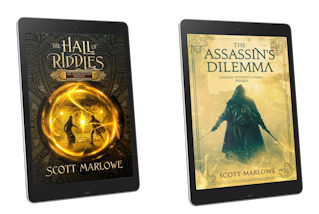
For this novel, I want everything to happen in one place. In my first novel, The Hall of the Wood, it's a journey (of non-epic proportions) just to get to where the action is happening. Even when they do get there, they're running around in the woods quite a bit. I guess the latter can't be helped, whether it's the wilderness or a city. They can't exactly sit in a room the whole time. But, for this novel, I want the story to take place in only one place. No traveling about. I have a pretty good idea what sort of setting I'll be using, too.

2.) No ancient relics

No devices of ancient origin with powers waiting to be revealed.

3.) No fated heroes or special ancestry

Everyone has a past, but in this story no one will have a past all that extraordinary or far-reaching. Sure, they may have heroic or villainous deeds in their background, but it will be their background and not some legacy passed down from generation to generation.

4.) No characters with dark, personal secrets or pasts

Not all main characters have to have dark secrets hidden away to be gradually revealed to the reader. Such secrets all too often have something to do with the current antagonist. I'm as guilty of this one as the next writer. It's a trope that works well, albeit readers can sometimes grow tired of it, right? In this next novel, no deep, dark secrets. It's a road I just don't want to go down on this one.

5.) Minimal or no magic

I lean more and more towards this anyway as my world-building moves away from sorcery and to a sort of pseudo-science. I'm finding it's much more interesting than trying to think up the next great magic system or leaning too heavily on one that's already been done to death.

6.) Do have a strong supporting cast of characters

Main characters should be strong, smart, and daring, but they shouldn't be the only ones with the brains and the brawn. In this novel, the main character is going to be average in some ways, but exceptional in others. But one of the first things he does as the story gets rolling is setup his support infrastructure. I mean, where would Special Agent Jethro Gibbs be without his team? (sorry, the wife's got NCIS on in the other room)

7.) Do have villains who are motivated by more than just greed

Greed is nice, but all too often it can become the sole motivating force behind a villain. This tends to lead to flat or boring villains that we've all seen too often.

8.) Do research pertinent topics thoroughly

I research, but only enough to make it sound like I have some idea what I'm talking about. I'd like to take that a step further by infusing some authenticity into my writing. I don't know how this one will go; I'm all for basing certain things on reality, but I write fantasy, so… If nothing else, I have certain topics in mind that I'll like to read up on, if only to give myself ideas.

[ Follow me on Twitter ]

Writing Advice: Don't skip extra lines between paragraphs

by Scott Marlowe (@scottmarlowe) 5/29/2010 10:53:00 AM

I got a short story rejection back the other day. No big deal. It happens.

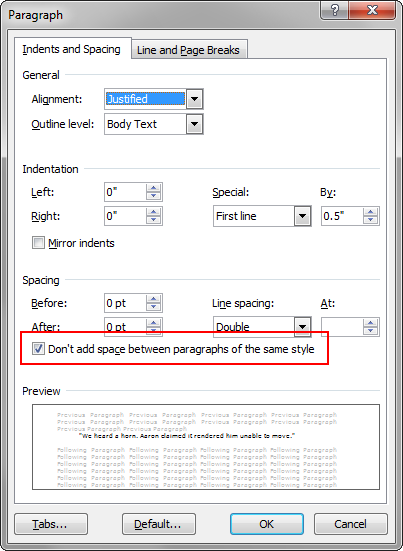
The rejection slip was of a form nature, though at the bottom was scrawled a small bit of advice:

Don't skip extra lines between paragraphs.

My first thought was: huh?

After a little investigation, however, I found this setting that was unchecked in Microsoft Word (it's obviously checked now):

image

Problem solved, and hopefully the next editor will be a little bit happier.

That story, by the way, is already back out to the next publisher.

[ Follow me on Twitter ]

Heinlein's Rules for Writing

by Scott Marlowe (@scottmarlowe) 4/17/2010 4:41:00 PM

Robert A. Heinlein was one of the "grand-daddy's" of science fiction. He lived from 1907 to 1988. In that time, he had a prolific writing career, with one of his most well-known works being Starship Troopers.

When someone like Heinlein gives writing advice, one should listen. While many others have called out these rules, I thought I'd list them here for my own benefit if nothing else. Here they are.

1.) You must write.

I'm reminded of similar advice given by Mur Lafferty of the I Should Be Writing podcast. Her first rule is "Butt in chair." It's as simple as that. Getting your butt in the chair is the first step to writing. Another way to look at it is that you must write if you want to be a writer.

2.) You must finish what you write.

If you don't, you're wasting time and effort. Sure, some writing is practice. The general rule on first novels is to shove it in a drawer and forget about it; most first novels are crap, so consider it practice and move on to the next one. However, if you never finish that first novel you'll never get to the second. It's not done until it's done, and you can't do anything with it until you've finished it.

3.) You must refrain from rewriting, except to editorial order.

This one is tough. I aspire to greatness. You probably do, too. My editing process involves several passes of the entire novel, then a chapter-by-chapter review. I hammer away at each and every chapter for as long as it takes. I risk exhaustion with this process, but it's what works for me. But at some point you have say, "I'm done", and resist all further temptations to re-write any more. If you think about it, a piece of writing is never really "done". There's always something to change or add or remove. But if you aspire to becoming a professional writer, then at some point you have to get your writing in front of someone who will pay you for it. That's not going to happen if you enter into a never ending rewrite cycle.

4.) You must put the work on the market.

You have to get your writing in front of someone who will pay you for it. Don't fear rejection. Embrace it and make yourself stronger from it. Or something like that. Bottom line: when you finish something, send it out.

5.) You must keep the work on the market until it is sold.

Once something is finished, send it out. If (or when) it comes back rejected, already have your next destination for it in mind. Only when all possible outlets have been exhausted should you consider stuffing it into a drawer or, if you're sure it's of high quality and representative of the kind of work you want people to read, put it on your web site or blog as a freebie.

Those are Heinlein's Rules of Writing. Robert J. Sawyer, author of Flash Forward and many other science fiction novels, adds a sixth rule to Heinlein's five:

6.) Start Working on Something Else

Once something is shipped, start working on the next story or novel. Not always easy, but it is essential to always have something in the pipeline. You might even find yourself juggling multiple, simultaneous projects. Some writers do this to keep from getting "stuck" when working on just a single project. The change in story or characters can really help keep the writing process flowing.

[ Follow me on Twitter ]

Stuff to Use Later

by Scott Marlowe (@scottmarlowe) 1/23/2009 10:06:00 PM

image I have a file that accompanies every one of my stories. It's called "stuff to use later.doc". This file contains sentences, paragraphs, snippets, possibly even entire chapters. Some of it is stuff that comes to mind before I've even started work on an outline. It might be a scene of dialog between two characters, or some information on setting. Then, once I've started writing or editing, I might toss into this file tidbits that are good, and that I like, but maybe don't quite fit into the story as it is right now.

The point of this file is simple: it gives me a place to throw things without throwing them away. I'm not a packrat, but when it comes to writing I don't delete anything unless I know with absolute certainty that it's crap. Even then I may hold onto it for a while longer, just in case.

Point in case: as I continue through a second edit of my current fantasy novel, I just came across a place where it hit me that a short scene I had previously chopped might fit quite nicely. I'm digging into my "stuff to use later" file now and will soon have it back in place.

Happy New Year

by Scott Marlowe (@scottmarlowe) 1/1/2009 8:22:00 PM

Happy New Year everyone!

With 2008 over, I decided to take quick stock of things with respect to my writing and blogging.

Writing

I spent all of this past year working on my current fantasy novel. I've been documenting the progress in a weekly series, so I won't go into that angle of it too much. The fact that I only worked on one "thing" is kind of disheartening. I've been thinking of trying my hand at short fiction, but most of my ideas tend towards a larger scope, so the novel format is really the best. But the idea of starting and finishing something in a reasonable amount of time is alluring.

I'm not one for New Year's resolutions. I'm already doing the things I want to do—writing, reading, cycling, programming. But were I to make a commitment of that kind it would be to finish my current novel. That, and to author more content-rich blog posts. I've been slacking a little lately only because I've been trying to focus on my writing. Blogging is great, but it's an aside and not the real purpose here.

Blogging

Of course, now I want to briefly look at my blogging progress. I started blogging in June of 2006. That first blog is still out there, and really just morphed into this one when I acquired the domain name that goes along with my real name. That happened in January 2008. Since then, I've penned 157 posts (this makes 158). Probably a third (or more) of those are from my weekend links and writing progress series. Also, I recently started a new blog, called itscodingtime.com, which focuses on technology and programming "stuff". It creates some more work for me, but I've increasingly needed a technical online presence and a place to organize my software engineering pursuits much like I organize my writing pursuits with this one.


So, a good year, I think. But there's more work to do. Good luck with your own pursuits and make 2009 a good one.

Thoughts from Brandon Sanderson

by Scott Marlowe (@scottmarlowe) 10/21/2008 9:20:00 AM

image I was going through my usual blog reading routine this morning and came across a link to some thoughts from Brandon Sanderson on his history as a writer. Brandon Sanderson was tagged to write the final volumes in Robert Jordan's Wheel of Time series, the first of which is The Gathering Storm. Jordan passed away before he could finish the series. The details of Sanderson's post are significant enough that I thought I would share.

Sanderson's Mistborn was a Tor Free E-book Giveaway back in July. He's also the guy tasked with completing Jordan's final Wheel of Time book after that author's death. There's also a recent video interview with the author that I came across.

The most profound thing I took away from Sanderson's post is that I (and I imagine many writers) found myself empathizing with many of his feelings and thoughts. I saw in his words some of the same questions I ask myself, such as "is this good enough?", "will this stand up to reader scrutiny?", "is anyone going to even want to read this let alone publish it?". It's, in an odd way, comforting.

At one point, Sanderson says this:

Here I was, having written twelve novels, and I seemed to be getting WORSE with each one. I wasn't selling, I was out of school working a wage job graveyard shift, and my social life consisted pretty much of my friends taking pity on me and coming to hang out at the hotel once in a while.

Sounds rather dismal. The thing that really blew me away was his statement that he'd written twelve novels (twelve!) without a publishing credit to his name. That's disheartening and inspiring at the same time. The latter because of his fortitude and perseverance, both obviously of heroic proportions.

Later, he says this:

I was NEVER AGAIN going to write toward the market.

After some initial failures, Sanderson changed tactics, trying to write what he thought publishers wanted. The results were sub-standard work simply because his heart was not in the material. The above statement marks a turning point, whereupon he decides to write for himself. He finds success not too long after that.

On that last point, I've seen it go the other way, too. I know of one writer in particular who also faced some small amount of defeat in getting published before he also decided to change tactics—study the market, see what publishers were buying (and what people were reading)—then take that information and write. The result was his first sale of many.

In light of that, it would seem there's no foolproof approach. What works for some may not work for others. It's both inspiring and sobering to read such posts as Sanderson's, though. Go check it out.

Download The Career Novelist for free

by Scott Marlowe (@scottmarlowe) 10/10/2008 7:50:00 AM

cn_largeIf you've been on the hunt for an agent you've no doubt heard of Donald Maass.

Maass has written a number of excellent books on writing and the writing process, amongst them Writing the Breakout Novel and The Career Novelist, the latter of which is now being offered as a free .pdf download.

From the book's introduction:

IT IS THE DREAM OF HUNDREDS OF THOUSANDS, PERHAPS OF millions, to write fiction full-time. This dream has a powerful allure. To do nothing but create, to spend one's working hours in the dream state of one's imagination—who wouldn't treasure that? Making that dream a reality is the subject of this book.

I read The Career Novelist many years ago. I do wonder how relevant all of the information is given that the book was written in 1996, but, hey, it's a free download, and Maass has a wealth of experience in the literary field. I've no doubt there's a lot of good stuff in there.